
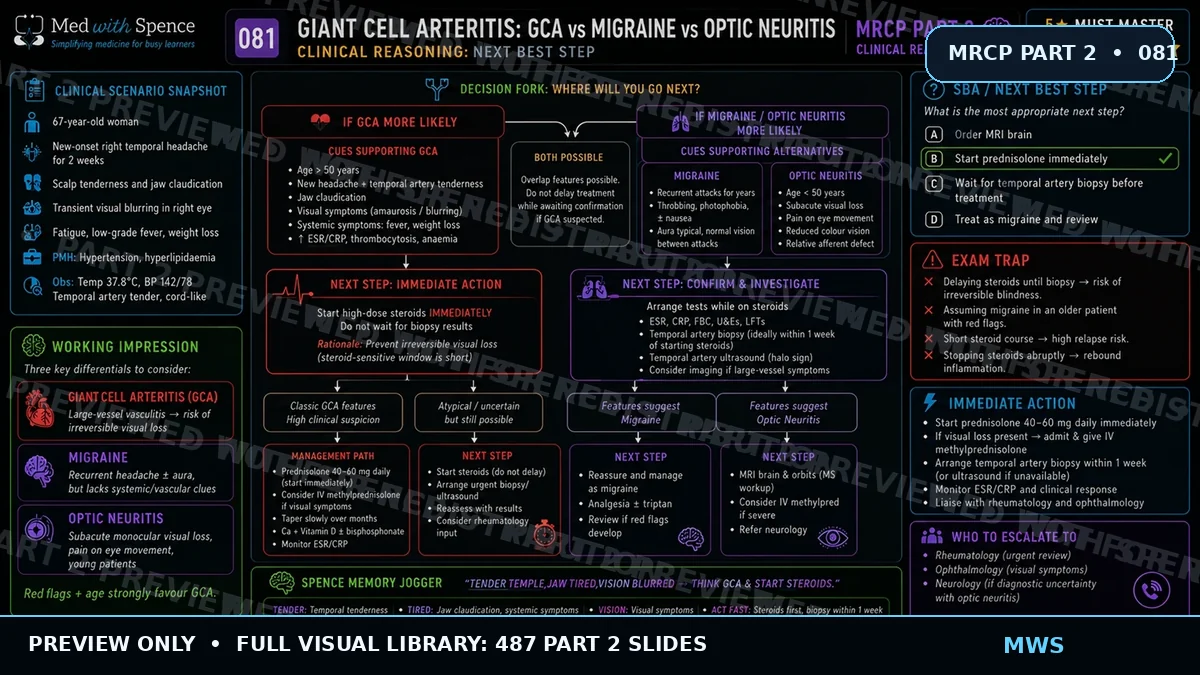
What MRCP Part 2 written tests
MRCP Part 2 written builds on Part 1 and tests application. The official examination currently uses two three-hour papers with 100 best-of-five questions each and no negative marking. Questions ask candidates to interpret information, prioritise diagnoses, choose investigations, select immediate and long-term management and assess prognosis.
Why Part 2 feels different from Part 1
Part 1 often rewards knowing the underlying fact. Part 2 more often asks what the fact means in context. You may recognise the diagnosis yet still lose the mark because the question is asking for the first investigation, immediate treatment, safest escalation or most likely prognosis.
Revision should therefore move from “What is this?” to:
- What is the decisive clue?
- Which plausible alternative is less correct?
- What must happen now?
- Which investigation changes management?
- What would make this patient unstable?
The Part 2 reasoning workflow
- Read the final line first. Identify whether the question asks for diagnosis, investigation, management or prognosis.
- Build a one-sentence problem representation. Age, tempo, system, severity and key discriminator.
- Separate recognition from action. Knowing the diagnosis does not automatically identify the next step.
- Check stability. Immediate threats override elegant diagnostic plans.
- Compare the nearest mimic. Decide which single clue makes one option more correct.
- Review the error as a reasoning step. Diagnosis, test selection and management should be tracked separately.
An eight-to-twelve-week plan
| Phase | Focus |
|---|---|
| Weeks 1–3 | Specialty blocks, interpretation practice and guideline-sensitive management |
| Weeks 4–7 | Mixed questions, image/ECG interpretation and nearest-mimic comparisons |
| Weeks 8–10 | Timed papers, error taxonomy and rapid visual consolidation |
| Final 1–2 weeks | Fragile management rules, high-confidence errors and exam-day pacing |
How to improve image and data interpretation
Do not describe every visible feature. Use a fixed sequence:
- identify modality or data type;
- assess quality and orientation;
- state the dominant abnormality;
- connect it to the clinical stem;
- decide what the abnormality changes.
For ECGs, imaging, blood films, dermatology and ophthalmology, repeated exposure is necessary—but explanation quality matters. Record the visual discriminator that separated the correct answer from the nearest plausible option.
Management questions: prioritise before you memorise
Part 2 management errors frequently come from choosing a treatment that is correct eventually but not correct first. Build each topic around:
- immediate stabilisation;
- first-line disease-specific treatment;
- definitive management;
- monitoring and complications;
- when to escalate or involve a specialist.
Guideline-sensitive topics should display the source and review date. Avoid relying on old memory codes when national recommendations have changed.
Common Part 2 mistakes
- Answering the diagnosis when the question asks for management.
- Ordering the definitive test before stabilising an unstable patient.
- Choosing a technically possible but unnecessarily invasive investigation.
- Overweighting one dramatic detail and ignoring the overall pattern.
- Reviewing a whole topic instead of the exact failed reasoning step.
- Memorising guidelines without understanding the clinical trigger.
The final week for Part 2
Use short mixed sets and visual review of repeated errors. Rehearse decision sequences: recognise, discriminate, investigate, treat and protect. Avoid attempting to memorise every guideline paragraph. Focus on the trigger that changes management and the safest next step.
Frequently asked questions
Is MRCP Part 2 written harder than Part 1?
How should I revise images for Part 2?
Do I need to memorise every guideline?
Should I use Part 1 notes for Part 2?
Official sources and editorial note
Exam format information was checked against the official MRCP(UK) website on 30 July 2026. Examination dates, fees and delivery arrangements can change, so candidates should confirm the current position directly with MRCP(UK).
Independent educational guidance only. Med with Spence is not affiliated with MRCP(UK) or the Royal Colleges of Physicians.

Dr Sunney Salhan
NHS clinician, medical educator and creator of Med with Spence. The platform is designed to help busy doctors turn question-bank errors into clear, memorable clinical reasoning.
Founder credentials and editorial standards →Turn revision errors into clinical mental models.
Try ten free MRCP Part 1 visuals or explore the full Clinical Reasoning OS.