
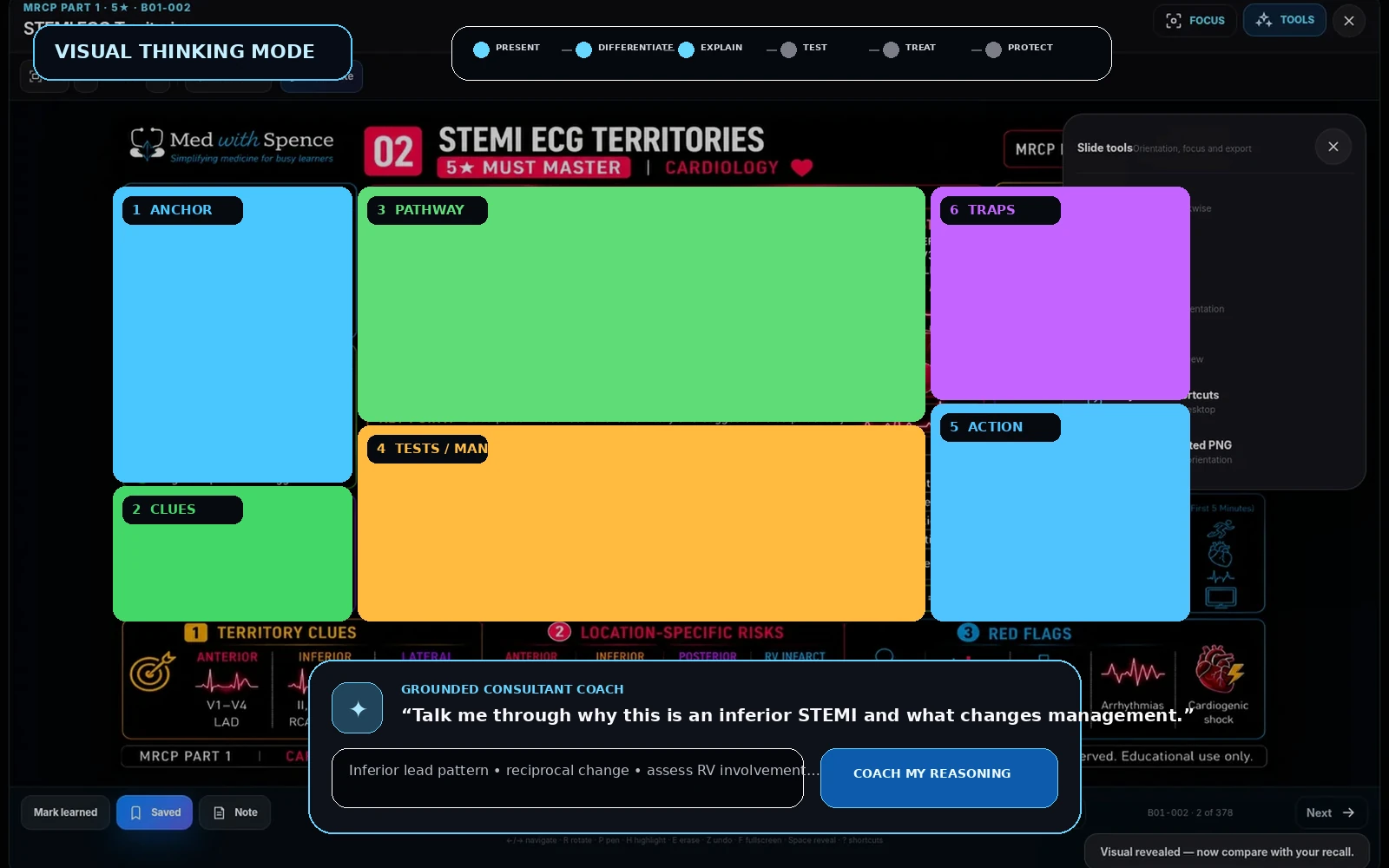
What clinical reasoning means in exams and practice
Clinical reasoning is the process of turning patient information into a safe working diagnosis and action plan. It includes data gathering, pattern recognition, analytic comparison, risk assessment and management prioritisation.
In written exams, reasoning is compressed into a short stem. In practice, the information is incomplete and evolves over time. The same disciplined structure helps in both settings.
A six-step clinical reasoning framework
Build a one-sentence problem representation
Compress the case into age or context, time course, system, severity and discriminator. For example:
Older patient with chronic kidney disease, progressive weakness, severe hyperkalaemia and ECG changes requiring immediate membrane stabilisation.
A useful representation filters noise and makes the next decision easier.
Compare the nearest mimic
Long differential lists are often less helpful than comparing the two most plausible options. Ask:
- Which feature supports both?
- Which single feature separates them?
- Would the first investigation differ?
- Would immediate management differ?
- Which diagnosis is dangerous to miss?
Turn wrong answers into reasoning data
Record why the answer was wrong:
| Error type | Corrective action |
|---|---|
| Knowledge gap | Learn the missing fact or mechanism |
| Missed discriminator | Compare the nearest mimic |
| Investigation sequence | Rebuild first test → confirmatory test |
| Management priority | Separate stabilisation from definitive treatment |
| Confident misconception | Correct with evidence and schedule urgent review |
How to practise clinical reasoning deliberately
- Commit to an answer before reading the explanation.
- State your reasoning aloud in one or two sentences.
- Identify the exact clue that made the answer most correct.
- Explain why the strongest distractor was less correct.
- Link the decision to a visual or guideline source.
- Re-test the failed step later in a different case.
Frequently asked questions
Can clinical reasoning be improved?
What is the difference between pattern recognition and analytic reasoning?
Why do I get management questions wrong after recognising the diagnosis?
How does Med with Spence teach clinical reasoning?
Official sources and editorial note
Exam format information was checked against the official MRCP(UK) website on 30 July 2026. Examination dates, fees and delivery arrangements can change, so candidates should confirm the current position directly with MRCP(UK).
Independent educational guidance only. Med with Spence is not affiliated with MRCP(UK) or the Royal Colleges of Physicians.

Dr Sunney Salhan
NHS clinician, medical educator and creator of Med with Spence. The platform is designed to help busy doctors turn question-bank errors into clear, memorable clinical reasoning.
Founder credentials and editorial standards →Turn revision errors into clinical mental models.
Try ten free MRCP Part 1 visuals or explore the full Clinical Reasoning OS.