
What MRCP Part 1 actually tests
MRCP Part 1 is a two-paper, best-of-five examination. The official format currently contains 100 questions in each three-hour paper, with no negative marking. It tests the clinical sciences, common and important disorders, interpretation and problem solving—not isolated fact recall alone.
Your revision therefore needs three layers: a broad knowledge base, repeated question practice, and a system for consolidating the errors and near-misses that question banks expose.
The most effective revision system
A reliable Part 1 workflow is:
- Learn the pattern. Build a concise clinical mental model before memorising detail.
- Answer questions early. Questions reveal what you cannot retrieve under pressure.
- Classify the error. Was it a knowledge gap, missed discriminator, formula error, guideline detail or overthinking?
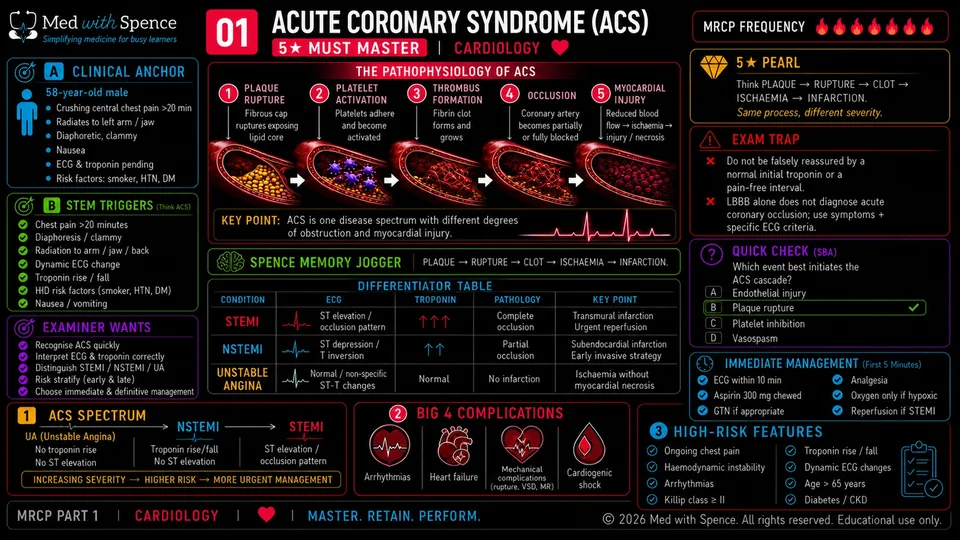
- Consolidate visually. Convert the error into a one-screen structure containing the anchor, clue, mechanism, tests, management and trap.
- Revisit at increasing intervals. Review fragile topics more often than secure ones.
This is why Med with Spence is designed to sit alongside a question bank rather than replace it. The questions find the gap; the visual helps build the memory.
How long should you prepare?
There is no universal preparation period. A doctor working full-time with a strong recent medical knowledge base may work effectively over eight to twelve weeks. Candidates returning after a long gap, working heavy rotas or studying in a second language may need longer.
| Starting position | Suggested approach |
|---|---|
| Recent finals or strong core knowledge | 8–10 focused weeks |
| Full-time rota with mixed confidence | 10–14 weeks |
| Previous unsuccessful attempt | Begin with an error audit, then 10–12 targeted weeks |
| Long gap from general medicine | 12–16 weeks with a longer foundation phase |
Use an exam date to create urgency, but plan using available weekly hours—not an idealised timetable you cannot sustain.
A practical weekly structure
Each week should combine breadth, retrieval and correction:
- Four question sessions: timed or tutor mode depending on phase.
- Two consolidation sessions: revisit incorrect and uncertain topics.
- One mixed review: interleave specialties to prevent context-dependent memory.
- One progress check: inspect accuracy, confidence and repeated error types.
During the final third of preparation, mixed timed sets should gradually replace specialty-by-specialty blocks.
How to prioritise high-yield topics
The official blueprint gives a useful indication of likely topic weighting, but the actual distribution may vary. Clinical sciences and clinical pharmacology deserve deliberate time, while cardiology, endocrinology, gastroenterology, infectious diseases, neurology, renal and respiratory medicine each contribute substantial numbers of questions.
High yield does not mean ignoring smaller specialties. It means:
- secure the frequent topics first;
- prevent catastrophic gaps in lower-volume specialties;
- review formulas, statistics and pharmacology repeatedly;
- use mixed questions to test discrimination between plausible options.
Common preparation mistakes
- Waiting to finish the textbook before starting questions. Retrieval practice begins too late.
- Counting questions rather than analysing errors. Volume without correction creates false progress.
- Repeatedly reading explanations. Recognition feels easier than recall.
- Ignoring low-confidence correct answers. They are fragile knowledge, not secure knowledge.
- Using too many resources. Switching systems fragments attention and wastes revision time.
- Leaving statistics and pharmacology until the end. Both benefit from repeated spaced exposure.
The final seven days
The final week is for retrieval and calibration—not rebuilding the entire syllabus. Prioritise:
- repeatedly missed high-frequency topics;
- clinical sciences, statistics and drug effects that decay quickly;
- short mixed timed sets;
- sleep, travel and examination logistics;
- stopping heavy new learning early enough to protect performance.
Avoid interpreting one difficult question set as evidence that you are unprepared. Use trends across multiple sessions.
Frequently asked questions
What is the best question bank for MRCP Part 1?
Should I finish all questions before the exam?
Are visual notes enough for MRCP Part 1?
How many hours a day should I revise?
Official sources and editorial note
Exam format information was checked against the official MRCP(UK) website on 30 July 2026. Examination dates, fees and delivery arrangements can change, so candidates should confirm the current position directly with MRCP(UK).
Independent educational guidance only. Med with Spence is not affiliated with MRCP(UK) or the Royal Colleges of Physicians.

Dr Sunney Salhan
NHS clinician, medical educator and creator of Med with Spence. The platform is designed to help busy doctors turn question-bank errors into clear, memorable clinical reasoning.
Founder credentials and editorial standards →Turn revision errors into clinical mental models.
Try ten free MRCP Part 1 visuals or explore the full Clinical Reasoning OS.