
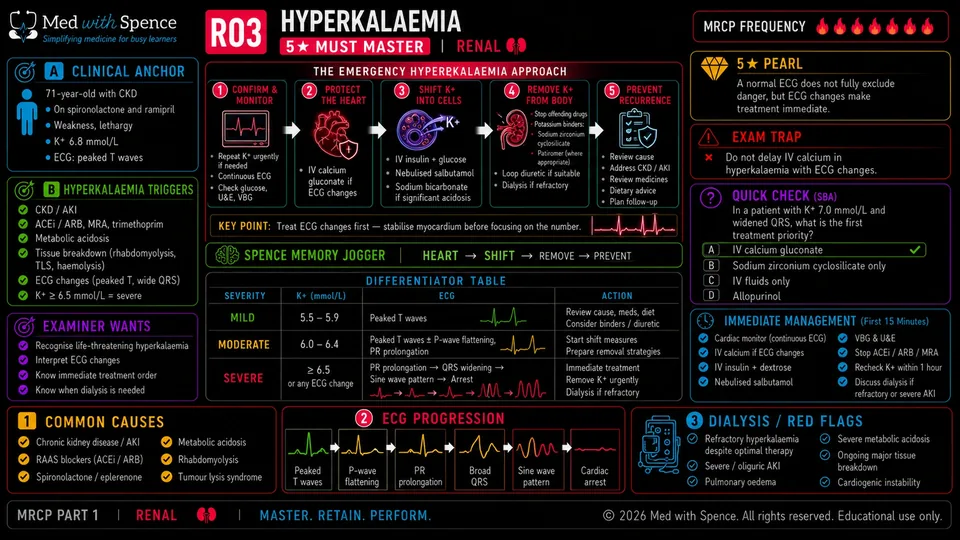
What good MRCP notes should do
Good notes are not a second textbook. They should make the next retrieval easier. A useful one-page topic summary should answer:
- What is the clinical anchor?
- Which clue separates this from the nearest mimic?
- What is the mechanism or pathway?
- Which investigation comes first and which confirms?
- What is the immediate and definitive management?
- What is the classic exam trap?
Why visual structure matters
Consistent spatial structure reduces the effort needed to navigate a topic. If the clinical anchor always appears in one area and management in another, the layout becomes part of the memory cue. Visual structure should support the hierarchy; decoration should never compete with clinical meaning.
How to make your own high-yield notes
- Start from a question you missed or answered uncertainly.
- Write a one-sentence clinical anchor.
- Add no more than three decisive clues.
- Draw the shortest mechanism that explains the findings.
- Separate immediate from definitive management.
- Add the distractor or misconception that fooled you.
- Test the note later without looking.
Digital notes, paper notes or screenshots?
The medium matters less than retrieval. Digital notes are searchable and easy to update; handwritten notes may support generation and attention; screenshots are fast but can become an unreviewed archive. Whichever method you choose, schedule the note to return.
Using a visual library efficiently
Do not read hundreds of visual pages in order. Use the library to:
- consolidate a question-bank error;
- preview a weak specialty before questions;
- review high-frequency topics in the final weeks;
- compare similar conditions;
- revisit only the reasoning chunk that remains fragile.
Try the visual language
Med with Spence provides ten free Part 1 visuals so candidates can judge the density, structure and readability before purchasing.
Frequently asked questions
Are handwritten notes better for MRCP?
Should I make notes for every question?
Can I revise from notes without a question bank?
How often should I review notes?
Official sources and editorial note
Exam format information was checked against the official MRCP(UK) website on 30 July 2026. Examination dates, fees and delivery arrangements can change, so candidates should confirm the current position directly with MRCP(UK).
Independent educational guidance only. Med with Spence is not affiliated with MRCP(UK) or the Royal Colleges of Physicians.

Dr Sunney Salhan
NHS clinician, medical educator and creator of Med with Spence. The platform is designed to help busy doctors turn question-bank errors into clear, memorable clinical reasoning.
Founder credentials and editorial standards →Turn revision errors into clinical mental models.
Try ten free MRCP Part 1 visuals or explore the full Clinical Reasoning OS.