
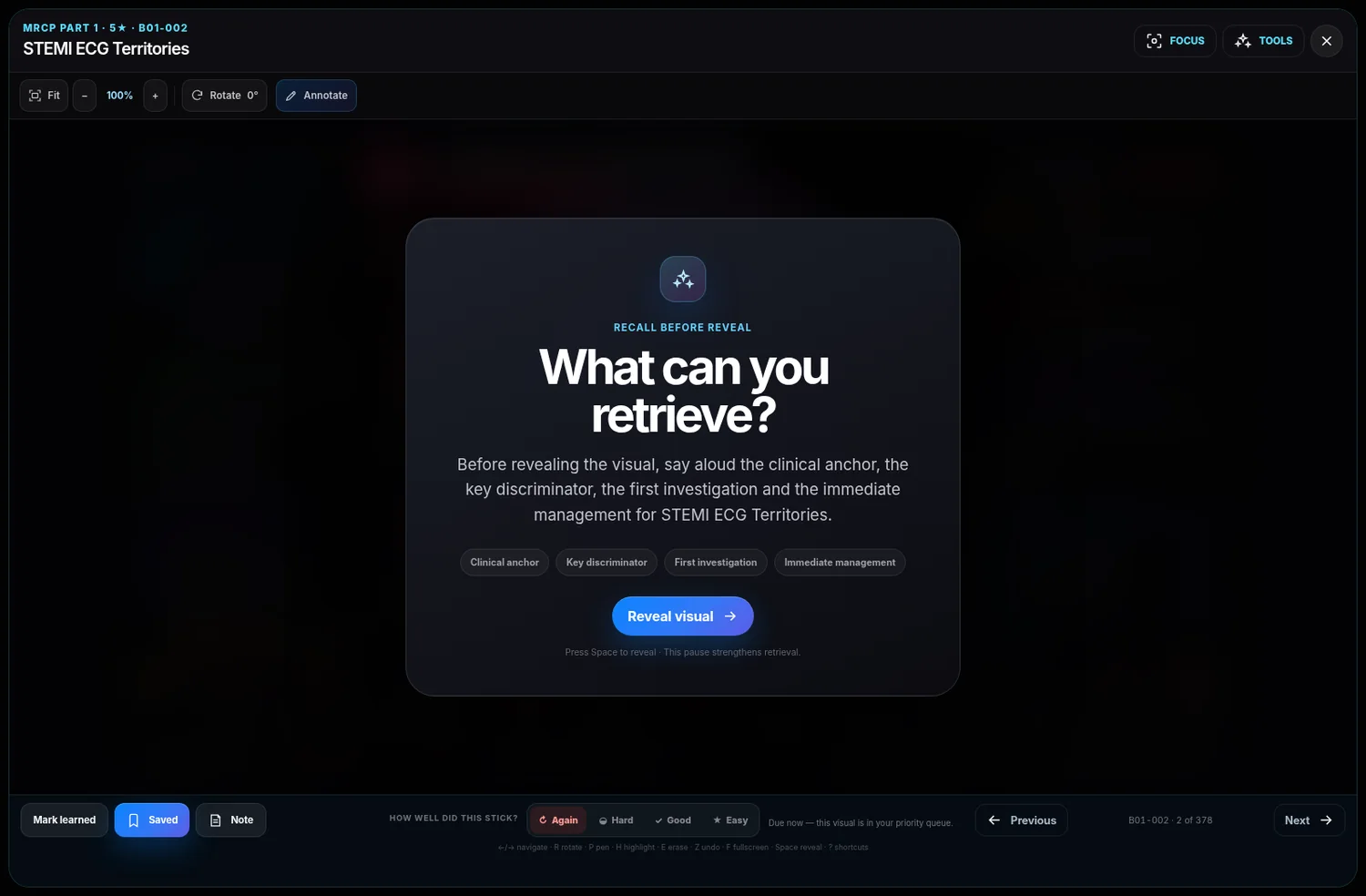
What active recall actually means
Active recall requires attempting to retrieve information before seeing it. Highlighting, rereading and recognising a diagram are not retrieval.
Use clinical prompts, not only isolated flashcards
Prompt the decision:
- What are the three discriminating clues?
- Which investigation comes first?
- What must be treated before the number?
- Which finding changes urgency?
- Why is the nearest mimic less likely?
Add confidence calibration
Record confidence before checking. A wrong high-confidence answer is a misconception and should return urgently. A correct low-confidence answer is fragile and needs reinforcement.
Space reviews based on evidence
Short intervals suit failed or hinted recall. Longer intervals suit fast, correct and confident retrieval. Do not use the same schedule for every topic.
Active recall with visual notes
Cover a stable region—diagnosis, pathway, investigations or management—then reconstruct it. Reveal only the relevant chunk, explain it aloud and rate recall.
Frequently asked questions
Is active recall the same as doing questions?
How often should I use active recall?
What if I cannot remember anything?
Are flashcards enough for MRCP?
Official sources and editorial note
Exam format information was checked against the official MRCP(UK) website on 30 July 2026. Examination dates, fees and delivery arrangements can change, so candidates should confirm the current position directly with MRCP(UK).
Independent educational guidance only. Med with Spence is not affiliated with MRCP(UK) or the Royal Colleges of Physicians.

Dr Sunney Salhan
NHS clinician, medical educator and creator of Med with Spence. The platform is designed to help busy doctors turn question-bank errors into clear, memorable clinical reasoning.
Founder credentials and editorial standards →Turn revision errors into clinical mental models.
Try ten free MRCP Part 1 visuals or explore the full Clinical Reasoning OS.